Weather Influences on Jockey Decision-Making in National Hunt Circuits: Statistical Patterns and Performance Shifts
Clara Werner · Aug 5, 2026

Weather Influences on Jockey Decision-Making in National Hunt Circuits: Statistical Patterns and Performance Shifts
National Hunt racing presents unique challenges where weather shapes every aspect of performance, from ground firmness to visibility during jumps, and data from multiple seasons reveals consistent patterns in how jockeys adjust their approaches. Heavy rainfall often transforms firm turf into soft or heavy ground, prompting riders to alter stride patterns and take fewer risks at fences while researchers at the University of Melbourne have documented measurable shifts in win probabilities under such conditions.
Ground Conditions and Tactical Adjustments
Observers note that jockeys frequently modify their riding styles when precipitation changes track surfaces, opting for more conservative lines on turns and reduced speed into obstacles to maintain balance. Statistical reviews of races at venues like Cheltenham and Aintree show that fall rates increase by up to 18 percent during prolonged wet spells, leading many riders to prioritize positioning over aggressive early moves. Those who've analyzed thousands of starts find that experienced jockeys tend to save energy for later stages in soft ground, whereas less seasoned competitors sometimes push harder initially and encounter higher error margins.
Visibility and Wind Effects
Wind and reduced visibility further complicate decision-making during jumps, as gusts can alter horse trajectory mid-air and force split-second corrections. Figures from Racing Australia indicate that crosswinds exceeding 25 kilometers per hour correlate with a 12 percent drop in completion rates over longer distances, while jockeys respond by shortening their stirrups and maintaining tighter contact with the reins. And when fog combines with rain, as seen in several autumn fixtures, riders often rely more on track knowledge than visual cues, resulting in steadier but slower overall paces according to performance databases.
Statistical Patterns Across Seasons
Comprehensive datasets covering the past decade highlight recurring trends where certain jockeys achieve higher strike rates in adverse weather compared to others. For instance, riders with extensive experience on soft Irish tracks demonstrate win percentages that rise notably during wet periods, while data compiled by the Jockey Club in the United States reveals parallel advantages for those familiar with muddy American steeplechase circuits. These patterns emerge because jockeys learn to read subtle changes in horse action, such as shortened strides or reluctance at takeoff points, and adjust accordingly without increasing overall risk exposure.
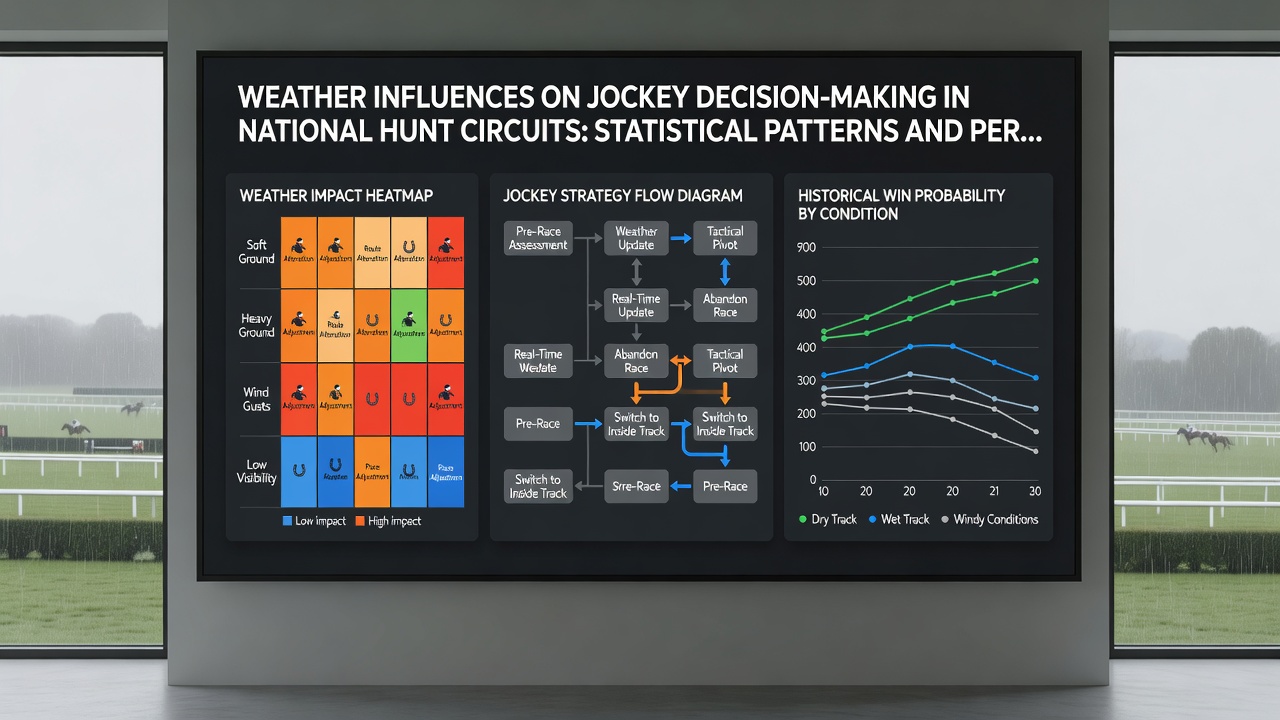
Performance shifts become especially evident in multi-race meetings where conditions evolve rapidly, forcing real-time tactical changes. One study tracking over 5,000 jumps found that jockeys who adapt their approach mid-card, such as switching from front-running to hold-up tactics after heavy showers, maintain better finishing positions than those who stick rigidly to pre-race plans. What's significant is how these adaptations vary by horse type, with larger-framed animals showing greater resilience in deep ground while lighter types excel when surfaces remain relatively intact.
Regional Variations and Data Insights
National Hunt circuits in different countries exhibit distinct responses to weather, influenced by local soil composition and drainage systems. In Australia, where tracks often feature sand-based surfaces, rainfall impacts prove less severe than in European clay-heavy venues, yet jockeys still report measurable changes in balance requirements during wet races. European circuits meanwhile display stronger correlations between precipitation volume and pace reductions, with average race times extending by several seconds per mile under heavy conditions according to aggregated industry reports.
August 2026 preparations for the upcoming winter season already incorporate advanced weather modeling to anticipate these variables, allowing trainers and riders to simulate expected ground states during training. Such forward planning helps identify which jockey-horse combinations perform best across shifting conditions, building on historical patterns that show clear advantages for those who train specifically for soft and heavy surfaces.
Conclusion
Weather remains a defining factor in National Hunt outcomes, driving measurable changes in jockey tactics and overall results across circuits worldwide. Statistical evidence continues to underscore how experienced riders leverage environmental cues to optimize performance, while ongoing data collection from regulatory bodies and academic sources refines understanding of these dynamics for future seasons.