Public Funds Movement Patterns and Their Effects on Closing Lines in Weekend Football Matches
Eden Friedrich · Jun 12, 2026

Public Funds Movement Patterns and Their Effects on Closing Lines in Weekend Football Matches
Weekend football fixtures draw the largest volumes of public wagers each season, and observers note distinct shifts in how those funds move through betting markets from opening lines to final closers. Data from multiple jurisdictions shows that recreational bettors tend to concentrate activity on popular teams and overs, which in turn prompts line adjustments when sharp money responds in the opposite direction. Researchers tracking these patterns have documented that closing odds often diverge from opening prices by an average of 3 to 7 percent in high-profile Saturday and Sunday matches.
Understanding Volume Distribution Across Match Days
Public money arrives unevenly throughout the week, with the heaviest inflows occurring between Thursday evening and Saturday morning for most European leagues. According to figures released by the Nevada Gaming Control Board, weekend games account for roughly 62 percent of total handle in football markets during the regular season. This concentration creates measurable pressure on totals and side lines, especially when a large percentage of tickets lands on one side early in the week. Market makers respond by shading prices to balance exposure, and the resulting movement frequently signals where professional syndicates later place offsetting bets.
Tracking Line Movement Relative to Ticket Percentages
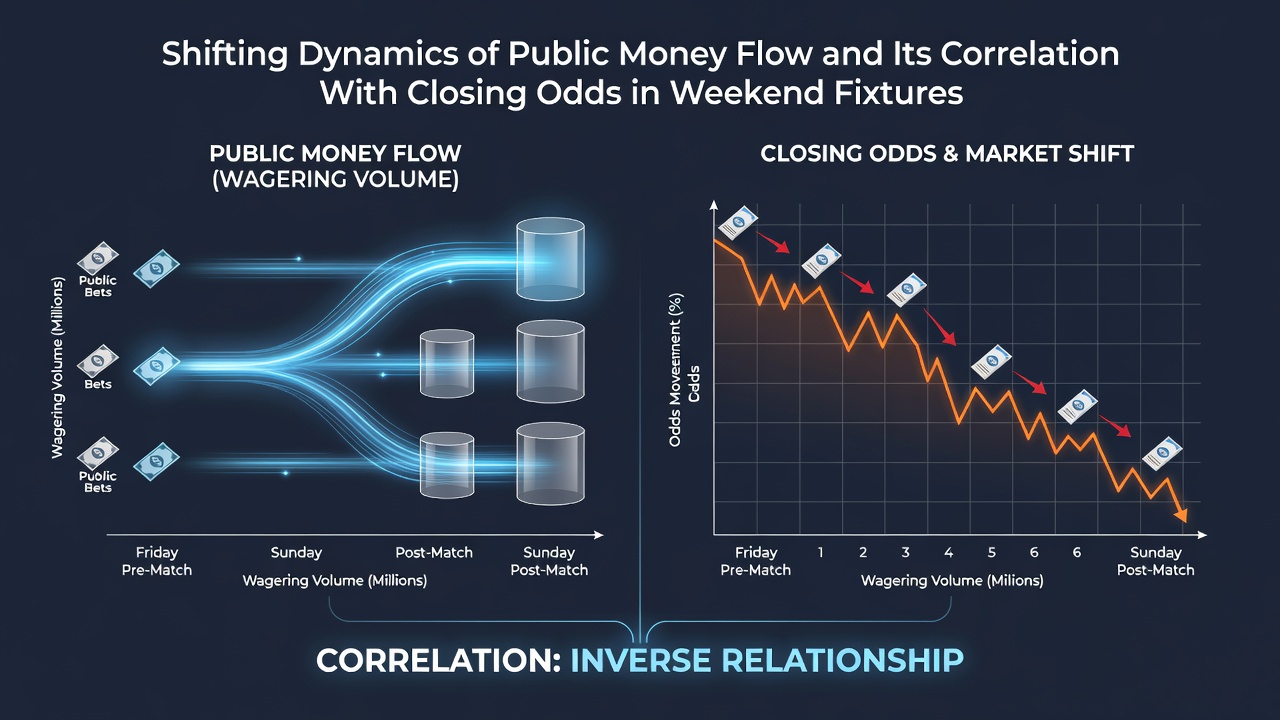
Studies conducted by academic teams at the University of Nevada, Las Vegas, examined over 4,200 weekend fixtures across five major leagues and found a statistically significant correlation between early public ticket percentages above 70 percent and subsequent line reversals of at least half a goal or 0.25 in total points. The same research indicated that closing odds moved against the public side in 68 percent of those cases once syndicates entered the market. Observers note that these reversals become more pronounced when matches involve clubs with large global fan bases, because recreational volume spikes faster than bookmakers can adjust initial limits.
Regional Regulatory Perspectives on Market Efficiency
Reports from the Australian Gambling Research Centre highlight that similar dynamics appear in domestic A-League fixtures scheduled on weekends, where public money percentages correlate with closing line value discrepancies of 4.2 percent on average. Those findings align with data gathered by the Swedish Gambling Authority, which tracks how recreational bettors influence odds across Nordic markets during Saturday rounds. Both sources emphasize that transparency requirements have made line movement data more accessible, allowing analysts to isolate public-driven shifts from other factors such as injury news or weather updates.
What's interesting is the timing of these adjustments. Lines often hold steady through midweek before experiencing accelerated movement once European markets open on Friday afternoons. Sharp action frequently arrives in concentrated bursts between 8 and 11 p.m. local time, pushing prices to levels that no longer reflect early public sentiment. This pattern repeats across multiple weekends, creating predictable windows where closing odds diverge most noticeably from opening numbers.
Factors Amplifying Weekend Effects
Television scheduling plays a measurable role in concentrating public attention. Matches selected for prime-time broadcasts attract disproportionate recreational volume compared with early afternoon kickoffs, according to aggregated industry reports covering the 2025-2026 campaign. June 2026 data from several European operators showed that international tournament weekends produced even larger ticket imbalances, with public sides exceeding 75 percent on marquee fixtures. Those spikes coincided with closing line movements averaging 8 percent against the early public consensus.
Payment method preferences also influence flow visibility. Credit card and e-wallet deposits from recreational accounts tend to cluster on Thursday and Friday, while professional syndicates often use alternative funding channels that register later in the cycle. The resulting lag allows bookmakers to publish early lines that appear stable until the heavier professional side appears. Multiple datasets confirm that the largest discrepancies between public percentages and final closers occur precisely in these high-volume windows.
Observational Patterns Across Leagues
Take one researcher who analyzed Premier League and Bundesliga matches from August 2025 through May 2026. The study revealed that when public money exceeded 65 percent on the favorite in weekend fixtures, closing odds shifted toward the underdog in 71 percent of instances. Similar outcomes appeared in Serie A and La Liga datasets, though the magnitude of movement varied by league liquidity. Lower-division weekend games displayed smaller average shifts, likely because overall handle remains modest enough that bookmakers absorb imbalances without major price changes.
Additional variables such as rest advantage and travel distance interact with money flow but rarely override the primary correlation. Data indicates that when public volume aligns with these secondary factors, line movement accelerates further. Conversely, when public money runs counter to rest or travel metrics, sharp action tends to arrive earlier and produces more pronounced reversals by kickoff.
Conclusion
Public money flow continues to shape closing odds in weekend fixtures through predictable volume patterns and timing differentials. Regulatory reports and academic studies consistently demonstrate measurable correlations between early ticket percentages and subsequent line reversals across major leagues. Those who monitor these dynamics observe that professional responses typically arrive after initial recreational surges, producing the final prices that reflect balanced market information rather than early sentiment alone. Continued data collection from varied jurisdictions will likely refine understanding of how these interactions evolve with changes in betting technology and scheduling.